NEWS via PdHeart:
Dear Members,
It is with great joy and excitement that I am writing to
let you know that this afternoon, the Secretary’s Advisory
Committee on Heritable Disorders in Newborns & Children
(ACHDNC)voted to recommend that pulse oximetry screening
for critical congenital heart disease be added to the
newborn screening uniform panel!!!
The recommendation now gets passed up to Secretary Sebelius
for review and approval. We're almost there!
AnnaMarie Saarinen just called with the news. She has
worked tirelessly to advocate for early diagnosis and
screening and has effectively spearheaded this important
effort. You can follow her blogs on http://1in100.org
Thank-you AnnaMarie for your hard work and determination.
Thanks also to Dr Gerard Martin who REALLY listened to my
impassioned pleas and worked so hard to implement model
screening programs. I tearfully and joyfully post
Annamarie's message below:
"At 2:40 eastern time today, the national committee
on newborn screening voted to YES to recommend pulse
oximetry screening for critical congenital heart disease be
added to the newborn screening uniform panel. I don't even
know what to say right now...still in shock. Was not
anticipating vote until January. Have to hug Eve and have a
major cry right now. It's due time...all babies are finally
going to be screened before discharge. Policy priority #1:
DONE!!!!!"
This is indeed a red letter day for all of us.
Our voices are being heard and yes, we CAN make a
difference!
My love to you all,
Mona
Saturday, September 18, 2010


Friday, September 17, 2010
Obsessed with the Boer War
I can't write blog posts or even watch TV. I am obsessed with the Boer War - a war between the British Empire and the Dutch/Afrikaner 'Boers' at the end of the 19th C. More particularly, I am obsessed with transcribing a diary kept by my Great Grandfather during his service among British forces in the Boer War.
The diary starts in September 1899 and I am now transcribing entries from mid December where he has just been placed in a unit manning a very big naval gun.
It is exciting stuff but written in cursive with some quaint spelling and a distinctly old fashioned punctuation (they don't use many full stops or comma's, preferring dashes everywhere). To further complicate my task, the diary was written in a carbon copy order book (probably from the book shop in Durban). Each page is numbered (good) but in some areas only the carbon copies remain - the originals having been, perhaps, mailed or shared with others. The remaining carbon has faded to the point of near illegibility and sometimes I puzzle for many minutes over a word or line.
To cover up my lack of blogging (nobody is complaining because my most loyal reader, my mother, is away at their beach cottage and my brother - according to Facebook - has LOST IT) I shall offer up a few pictures to console you before returning to life with Wren and Frost (which is really fine, Wren doing okay at preschool but looking a tad "forlorn" according to Fred.) I am not forlorn while he is at preschool so it kind of makes up for him being a tad sad.
Hluhluwe Game Reserve - September 5th 2010
The diary starts in September 1899 and I am now transcribing entries from mid December where he has just been placed in a unit manning a very big naval gun.
 |
| A page from the diary. |

To cover up my lack of blogging (nobody is complaining because my most loyal reader, my mother, is away at their beach cottage and my brother - according to Facebook - has LOST IT) I shall offer up a few pictures to console you before returning to life with Wren and Frost (which is really fine, Wren doing okay at preschool but looking a tad "forlorn" according to Fred.) I am not forlorn while he is at preschool so it kind of makes up for him being a tad sad.
Hluhluwe Game Reserve - September 5th 2010
 | |
| Entering the park, you are warned about the dangers of Elephants and ordered to remain entirely in the car without arms poking out windows etc. |
 |
| We liked the warning about elephants crossing which they did at times. |


 |
| Of course, pretty soon the Americans had their heads out the window. |

 |
| We watched this elephant for about 10 minutes while it ate most of this tree. Elephants are very hungry (aka destructive) and tear down trees for practice (aka fun) even when not that hungry. |
 |
| This is a very cute baby zebra until you realize it is peeing. We started to say that Wren was like a laxative for animals. Whenever he was looking they would pee or poop causing him a great deal of amusement. |
 |
| This giraffe did not pee so Wren found it boring. |
 |
| The first (white) rhino we saw. These rhino were walking through the burnt veldt which still had embers and small fires. |


 |
| Wren has a odd expression because he is eating sweeties (candy) He was often bribed with candy because he had to sit aroudn for long trips in the car. He also liked riding in the boot (trunk) and not having to wear a seat belt! God, I love seat belts. Unbelted children are a lot more of a nuisance! |
 |
| This buffalo is pooping. Yes, really. |


 |
| I just thought this was a really nice photograph. My best pictures are of zebra because they are relatively unconcerned by people and quite common. |

 |
| The View from somewhere over something but no animals. It was more often like this than the other pictures. |

 |
| At picnic spots you can get out of the car and use the bathroom. We saw nyala coming down to drink in the early morning when we stopped at this river side picnic site. |
 |
| .... and surprised some baboons eating seed pods on a tree. |
 | |
| We all love warthog. When alarmed, their tails stick straight up like aerials. |


Wednesday, September 15, 2010
First Day at Preschool
Today Wren started at his new preschool. He was very apprehensive and worried about the details. When I dropped him off he cried and stretched his arms out for me but I was firm and left.
Apparently he did 'well'. I think that "well" might be preschool-teacher-speak for "he was freaked out but we didn't have to call you."
 |
| Going to preschool this morning. |
Also, that they ate pasta for lunch and after lunch were allowed to have bread with honey.
And that it was TERRIBLE but ALRIGHT.
The whole Waldorf experience has already had an impact on Wren. He came home and went outside and spoke about fairies. In the park this afternoon during Frost's soccer practice, Wren looked for trees where the fairies might live.
Also, he decided he was a dog and ran around with his tongue hanging out and picked up sticks from the ground with his mouth. He also pretended to be a spider. He says that they did not do this at preschool but I suspect that there was some bestial child at preschool who inspired him.
He never wanted to be a dog before?
This evening, Frost asked to help prepare dinner. Apparently, his new teacher gives not too much homework and then allows them to do "alternative" homework including things like making dinner, doing sport and math or writing projects of their own devising. I like this teacher.
Before the Dinosaurs we lived in Magnolia
At breakfast this morning, Wren asked me who built our house.
I explained that our house was built "long ago" by someone (1949) but Daddy and I built the kitchen.
Then Wren wondered how much it cost. I told him it was a lot of money but we borrowed it from the bank. He said "Before that you lived in a truck?"
"No," I answered "before that we lived in Magnolia. You weren't born yet."
"Oh!" said Wren, everything now becoming clear. "That was when the dinosaurs were still OUT."
"What do you mean, 'out'?" I asked.
"Well, the dinosaurs were still out then" he repeated. "Now they are gone 'stinct. They DIED."
I wasn't quite sure where to go in the face of his bold compression of eras spanning millions of years into a scant decade. Even creationism is not as bold. Perhaps it is the power of the Waldorf Fairies.
Later, when I told Wren we are not going to buy something he wanted he suggested we "borrow the money from the bank."
Insurance / robbery update
Other good news is that Liberty Mutual is going to pay for both laptops and the camera stolen minus our $500 deductible. That makes it a lot less than it could have been. I am very impressed by them. I didn't have to fill in ONE FORM. The cynic in me wonders whether our premium will skyrocket next year, but the service has been great so a small increase would be justified now that they know we are high-risk travelers to Africa.
Backlog of photos
Because of the loss of my laptop and the abysmal slowness of the local connection, I didn't get to post much about the last weeks of our trip. I have a load of lovely pictures to which I am going to subject you. Right now, I don't have time to write enough to do them justice but here are a few of the kids while at the Lodge in Hilltop Camp at Hluhluwe Game Reserve. My many pictures of zebra will follow in the days ahead!
 |
| Wren, Frost and the Large Aloe |

 |
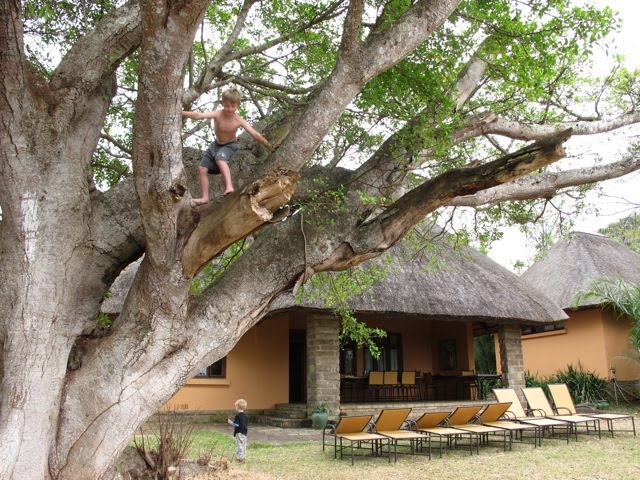
| Frost climbs a tree in front of the lodge. |
 | |
| The boys run down the road to the swimming pool. This picture speaks to what is missing in a more ordered life. I like the swimming pool being down a road by electric fence with bush-buck in the shrubbery and monkeys over head. This is the way it Should Be. |
Wednesday, September 8, 2010
Back to Seattle, takes time
 |
| Be chilled dude |
I am in a bit of a panic about the artifacts, although the lunch was great. Dad and Ingrid have a rather frantic and chaotic life. They manage their work and interests very well, but there is so much going on that other stuff is delegated to housekeepers, cleaners, handymen and others. Its hard to keep track of some things.
In the box of artifacts I found birth and death certificates of ancestors whose names I had never heard. I learned my Dads family came from Scotland, Glasgow.
I learned what my grandmother died of and found that the family antique toys have been badly damaged in the years since I was a child. Sigh.
Its hard being far away. I want to fix things that are really outside my control.
Anyway, here is Wren at lunch and a family picture from this afternoon. Hope to be home on Thursday afternoon Seattle time.
 |
| Family 'portrait' on the lawn |
Monday, September 6, 2010
The Road Home
Today we returned to Durban from Hluhluwe, 3 hours up the North Coast into Zululand. Like our earlier trip to Leisure Bay (down the South Coast)we took the N2 and enjoyed a bit of highway tourism.
Driving on freeways in South Africa is unlike the typical US experience. The roads are great - often two lane each way and well surfaced and marked. However, while cars are traveling at 120km/hr in a typical fashion, the highways are also used by people on foot or bicycle and the verges are used by cows and goats for grazing, occasionally spilling onto the edges of the road.
Driving down the South Coast we noticed that near rural settlements, the roads were used by men pushing supermarket carts filled with bits of scrap metal collected along the highway. Women sitting up upturned milk crates sold piles of avocados, paw-paw (papaya) and even crayfish. Ingrid told me that the fine for buying poached crayfish (like local lobster) is high and includes impounding any car used in illegal purchase. She also said that there is a story going around that locals store crayfish in their long-drop toilets to hide them and keep them fresh, which acts as a disincentive to commerce. The cynics claim this story was started by the Parks Board, tasked with enforcing the laws around poaching.
Pineapples vs Bananas
Up the North Coast, from Hluhluwe South of Richards Bay, stalls were erected from lashed twigs making high platforms where bowls of small pineapples enticed us alongside racks of carved wooden bowls and trays. From time to time we saw carvers working under trees near the highway, sitting on mounds of wood chips from their work. Other stalls sold woven grass mats and baskets and the occasional hand of bananas. The North Coast has huge fields of pineapples interspersed with sugar cane while the South Coast has similar fields of bananas, wrapped in blue plastic to prevent ripening on the tree.
Taxi Lanes
Highways also serve as public transport corridors. People walk along them between towns and settlements, hitch rides and cross lanes. Even children dash across four lane highways, hanging onto bags and packets as they do so. There are no official bus-stops on the highway itself, but the private minibus taxis run routes up and down the highways, stopping for passengers who gesture their destinations with hand signals, a sideways wave, a wrist flap or a thumb jerked backwards. Taxi pickups occur along the verge, a risky business because on single lane highways the emergency lane is used by slow vehicles and trucks to allow others to pass. When they are available, SOS highway telephones are used as taxi stops because they provide a small gravel pull-out where the taxi can avoid the high speed flow of traffic. [This is an issue for boys with a small bladder. There are almost no highway 'rest stops's so people stop and pee within clear view of traffic BUT its not safe to pull over where the verge is used by traffic.]
Flashing at Me
When you see a car coming up behind you, you pull to the side and continue at 100km/hr. The faster car passes to the right even when double white lines prevent conventional overtaking. When you have been passed in this manner, the faster car will often show their thanks by a quick flash of their hazard lights, acknowledged by a flash of headlights.
After a while I became quite paranoid about all the non-verbal communication going on. People routinely flash headlights to warn of police roadblocks, speed traps or hazards. They also flash to thank other cars for easy overtaking. Josh took over some of the non-verbal cues, always giving a hazard light flash of appreciation when we overtook, but half the time I wasn't sure what people were flashing about.
Aside: Dad's spot fine
Heading home from Lake Eland Reserve last week after dark, Dad was pulled over by a policeman waving a sparkling baton at a spot check road stop. The traffic policeman approached the car and asked for Dad's license. Dad explained he had left it in his jacket when he went out cycling for the day.
"Please get out of your car and come with me" said the policeman and Dad and he went off into the dark where the squad car was parked near some bushes.
We watched out the back window as Dad and the policeman talked at the open trunk of his squad car. Meanwhile, another policemen waved down and inspected a truck and a taxi.
A few minutes later Dad came back, muttering about them being "twits." He said he had been fined for not having his license on him. He said "I got a ticket."
When I asked how much the fine was, he said "He asked for R200 but I told him I would give him R120."
Josh and I were puzzled. It seems that police here don't have fixed numbers for "spot fines." The policeman told Dad that the fine was R1,000 if he didn't have a license but R200 if he had one but didn't carry it. Dad had the money out but he said that they were just looking for an excuse to fine him and it "was nonsense."
David tells me these "spot fines" are well known. The trick is to ask to pay the fine now, and the cost - in cash - is usually substantially less than any official fine. These spot fines are revenue raising ventures, but it is unclear how official they are or who they are raising fund for.
Fire Burning
It is customary to burn the canefields before harvest so there is often a lot of smoke around the coastal farmlands. The cane trucks, loaded with blackened cane which splays out between the triangular frames of their girders, are a constant reminder of the sugar industry, but even beyond the cane roadside fires are very common. Driving past, small fires often smolder along the verge and looking down from the road into an informal settlement it is common to see a fire burning in the reeds without any apparent concern from residents.
Although I have seen more fires in this visit than in my entire 10 years in the US, I have not seen a single fire truck or even official workers 'managing' a fire. A week before we went away, a large house in Dad
s neighborhood burned down and we have passed the double story brick house with its exposed and blackened beams sticking up like whale ribs into the sky. Even then, we didn't hear a fire truck coming to fight the fire (although one must have, eventually).
It took much of the day to leave Mtwazi and get home. First, Dad and I did a guided game walk which will be the subject of another post. We departed Hilltop around 10am but had to return to search for Soft Shirt which had been left behind under a bed [Josh felt that we should just drive off and let it be a natural ending to the soft shirt but I could not do it] and then we had various detours such as a crocodile farm and lunch in a Richards Bay mall. We got home at 4.30pm and have been unpacking and eating ever since :)
I have downloaded some pictures from David's camera to a memory stick. I hope to have pictures within the next few days or when we get back at the end of the week.
Driving on freeways in South Africa is unlike the typical US experience. The roads are great - often two lane each way and well surfaced and marked. However, while cars are traveling at 120km/hr in a typical fashion, the highways are also used by people on foot or bicycle and the verges are used by cows and goats for grazing, occasionally spilling onto the edges of the road.
Driving down the South Coast we noticed that near rural settlements, the roads were used by men pushing supermarket carts filled with bits of scrap metal collected along the highway. Women sitting up upturned milk crates sold piles of avocados, paw-paw (papaya) and even crayfish. Ingrid told me that the fine for buying poached crayfish (like local lobster) is high and includes impounding any car used in illegal purchase. She also said that there is a story going around that locals store crayfish in their long-drop toilets to hide them and keep them fresh, which acts as a disincentive to commerce. The cynics claim this story was started by the Parks Board, tasked with enforcing the laws around poaching.
Pineapples vs Bananas
Up the North Coast, from Hluhluwe South of Richards Bay, stalls were erected from lashed twigs making high platforms where bowls of small pineapples enticed us alongside racks of carved wooden bowls and trays. From time to time we saw carvers working under trees near the highway, sitting on mounds of wood chips from their work. Other stalls sold woven grass mats and baskets and the occasional hand of bananas. The North Coast has huge fields of pineapples interspersed with sugar cane while the South Coast has similar fields of bananas, wrapped in blue plastic to prevent ripening on the tree.
Taxi Lanes
Highways also serve as public transport corridors. People walk along them between towns and settlements, hitch rides and cross lanes. Even children dash across four lane highways, hanging onto bags and packets as they do so. There are no official bus-stops on the highway itself, but the private minibus taxis run routes up and down the highways, stopping for passengers who gesture their destinations with hand signals, a sideways wave, a wrist flap or a thumb jerked backwards. Taxi pickups occur along the verge, a risky business because on single lane highways the emergency lane is used by slow vehicles and trucks to allow others to pass. When they are available, SOS highway telephones are used as taxi stops because they provide a small gravel pull-out where the taxi can avoid the high speed flow of traffic. [This is an issue for boys with a small bladder. There are almost no highway 'rest stops's so people stop and pee within clear view of traffic BUT its not safe to pull over where the verge is used by traffic.]
Flashing at Me
When you see a car coming up behind you, you pull to the side and continue at 100km/hr. The faster car passes to the right even when double white lines prevent conventional overtaking. When you have been passed in this manner, the faster car will often show their thanks by a quick flash of their hazard lights, acknowledged by a flash of headlights.
After a while I became quite paranoid about all the non-verbal communication going on. People routinely flash headlights to warn of police roadblocks, speed traps or hazards. They also flash to thank other cars for easy overtaking. Josh took over some of the non-verbal cues, always giving a hazard light flash of appreciation when we overtook, but half the time I wasn't sure what people were flashing about.
Aside: Dad's spot fine
Heading home from Lake Eland Reserve last week after dark, Dad was pulled over by a policeman waving a sparkling baton at a spot check road stop. The traffic policeman approached the car and asked for Dad's license. Dad explained he had left it in his jacket when he went out cycling for the day.
"Please get out of your car and come with me" said the policeman and Dad and he went off into the dark where the squad car was parked near some bushes.
We watched out the back window as Dad and the policeman talked at the open trunk of his squad car. Meanwhile, another policemen waved down and inspected a truck and a taxi.
A few minutes later Dad came back, muttering about them being "twits." He said he had been fined for not having his license on him. He said "I got a ticket."
When I asked how much the fine was, he said "He asked for R200 but I told him I would give him R120."
Josh and I were puzzled. It seems that police here don't have fixed numbers for "spot fines." The policeman told Dad that the fine was R1,000 if he didn't have a license but R200 if he had one but didn't carry it. Dad had the money out but he said that they were just looking for an excuse to fine him and it "was nonsense."
David tells me these "spot fines" are well known. The trick is to ask to pay the fine now, and the cost - in cash - is usually substantially less than any official fine. These spot fines are revenue raising ventures, but it is unclear how official they are or who they are raising fund for.
Fire Burning
It is customary to burn the canefields before harvest so there is often a lot of smoke around the coastal farmlands. The cane trucks, loaded with blackened cane which splays out between the triangular frames of their girders, are a constant reminder of the sugar industry, but even beyond the cane roadside fires are very common. Driving past, small fires often smolder along the verge and looking down from the road into an informal settlement it is common to see a fire burning in the reeds without any apparent concern from residents.
Although I have seen more fires in this visit than in my entire 10 years in the US, I have not seen a single fire truck or even official workers 'managing' a fire. A week before we went away, a large house in Dad
s neighborhood burned down and we have passed the double story brick house with its exposed and blackened beams sticking up like whale ribs into the sky. Even then, we didn't hear a fire truck coming to fight the fire (although one must have, eventually).
It took much of the day to leave Mtwazi and get home. First, Dad and I did a guided game walk which will be the subject of another post. We departed Hilltop around 10am but had to return to search for Soft Shirt which had been left behind under a bed [Josh felt that we should just drive off and let it be a natural ending to the soft shirt but I could not do it] and then we had various detours such as a crocodile farm and lunch in a Richards Bay mall. We got home at 4.30pm and have been unpacking and eating ever since :)
I have downloaded some pictures from David's camera to a memory stick. I hope to have pictures within the next few days or when we get back at the end of the week.
Saturday, September 4, 2010
David is a Tick-Magnet
David, Josh, Dad and Ingrid went on a dawn guided walk. They got up at 5am and drove to a bush camp to walk for a few hours.
They saw nothing but, despite liberal spraying with insect repellent, David picked up a lot of ticks. This has earned him the nickname of Tick Magnet.
Ingrid says you can't be sure of seeing things but the ranger should have pointed out more of the smaller things along the way. Dad says that all the game has gone to the area around Memorial Gate (where we saw a lot on our morning drive). Josh says he had a good workout anyway. He had a nap this morning.
Tonight, we are going on a Night Drive in a tarpaulin-covered viewing truck. The truck is specially designed to raise you up higher for a good view of the bush to each side of the road. In a car, you can drive right by an elephant if its behind a bush or totally miss a hippo.
Frost and Wren enjoyed another swim/play session by the pool and we had dinner-for-lunch because the night drive is three hours and goes through dinner. The kids aren't coming (Wren is too young and Frost too impatient) so Dad has offered to stay with them.
While everyone else was being guided through the bush, I took Frost and Wren on a drive to Memorial Gate where we had one of our best game drives last night. We saw a couple of elephant right by the road, many giraffe, rhino and antelope. Still no lion.
This morning, we saw a hyena right by the road. No photos (because mine is being used by The Robber and David took his on the hike-seeing-nothing.
Still, a hyena is very cool.
We also saw another couple of elephants, buffalo, zebra, giraffe and various nyala and impala. The kids are learning the names of the animals which is an improvement from yesterday when Frost saw his first wild elephant from the reception terrace.
Frost: "ELEPHANT! That is one of the BIG FIVE!
Wren: THE BIG FIVE!
Frost: Now I only need to see lions and tigers and we will have seen them ALL!
Me: Not tigers.
Frost: Oh yeah! There are no tigers. Oops. Jaguars.. no, leopards! What is the difference between a jaguar and a leopard anyway?
My children are total tourists. I really cannot go incognito as a local.
We head home tomorrow lunch after a morning game walk for me and one other.
They saw nothing but, despite liberal spraying with insect repellent, David picked up a lot of ticks. This has earned him the nickname of Tick Magnet.
Ingrid says you can't be sure of seeing things but the ranger should have pointed out more of the smaller things along the way. Dad says that all the game has gone to the area around Memorial Gate (where we saw a lot on our morning drive). Josh says he had a good workout anyway. He had a nap this morning.
Tonight, we are going on a Night Drive in a tarpaulin-covered viewing truck. The truck is specially designed to raise you up higher for a good view of the bush to each side of the road. In a car, you can drive right by an elephant if its behind a bush or totally miss a hippo.
Frost and Wren enjoyed another swim/play session by the pool and we had dinner-for-lunch because the night drive is three hours and goes through dinner. The kids aren't coming (Wren is too young and Frost too impatient) so Dad has offered to stay with them.
While everyone else was being guided through the bush, I took Frost and Wren on a drive to Memorial Gate where we had one of our best game drives last night. We saw a couple of elephant right by the road, many giraffe, rhino and antelope. Still no lion.
This morning, we saw a hyena right by the road. No photos (because mine is being used by The Robber and David took his on the hike-seeing-nothing.
Still, a hyena is very cool.
We also saw another couple of elephants, buffalo, zebra, giraffe and various nyala and impala. The kids are learning the names of the animals which is an improvement from yesterday when Frost saw his first wild elephant from the reception terrace.
Frost: "ELEPHANT! That is one of the BIG FIVE!
Wren: THE BIG FIVE!
Frost: Now I only need to see lions and tigers and we will have seen them ALL!
Me: Not tigers.
Frost: Oh yeah! There are no tigers. Oops. Jaguars.. no, leopards! What is the difference between a jaguar and a leopard anyway?
My children are total tourists. I really cannot go incognito as a local.
We head home tomorrow lunch after a morning game walk for me and one other.
Friday, September 3, 2010
Hilltop Camp - Mtwazi Lodge
Last night we arrived at Hilltop Camp in the Ufolozi Hluhluwe game reserve. Its very dry and the horizon was yellow with smoke from a huge smouldering bushfire which left all the reserve black on one side of the road. We drove along one ridge line and the whole valley was burned and smouldering with spot fires as far as the eye could see, with a limited fire-line (Wren calls these "fire lions!") heading up the far hill.
Our "Guide to Hluhluwe" says that fires are a normal part of life in the area and are less common in a dry season because the brush is thin. Josh and I were amazed to be driving so close to the fireburnt area with many fires still burning. This was not one of those Australian bushfires!
View Larger Map
Shortly before entering the partk, those driving ahead in the first car (Josh, Wren, Dad and Ingrid) saw an elephant right by the road. We all saw white rhino, nyala, kudu and various small duiker and bushbuck. Other than that, animals have been a bit scarce. The usual waterholes have dried up and even the mud is firm and hard. The hippos have retreated out of view into the few ponds still available and we have yet to hear whether anyone has seen lions.
Still, the rhinos have been fabulous. Last night at dusk we went for a drive and saw a few crossing the road right in front of us. There were fallen logs burning white and red close to us and we could feel the heat from the fire but the rhinos were only concerned to cross the road and continue on their game trail. This morning (got the kids up at dawn) we saw a mother and calf.
Dad was thrilled to see a narina trogon (aka, the bird that looks like a parrot) on the walk to the lodge. We have booked for a morning game viewing hike tomorrow at dawn and for a night drive in the game viewing truck tomorrow evening.
Frost is sulky about getting up early and only complies because he is able to ride, unbuckled, in the trunk of the SUV. He has a big soft blanket and cuddles up in it and groans things like "how much longer? Are we THERE yet?" He did like to get out of the car at the picnic sight and saw nyala coming down to drink and spotted a troop of baboons running from the river, eating tasty seed pods and then galloping across the packed earth to the distant scrub. Game viewing by car is a slow process - you drive along at about 10 mph and look in the bush beside you for shadows or movement. If you are lucky someone else has spotted an animal and you can just stop and see what it is. Occasionally, animals cross the road in front of you and you get a glimpse of a buck. Larger animals can also hide and I have wondered how many elephants we have driven past already.
Still waiting to see my elephant!
Frost is excited to swim in the (icy) swimming pool and to find our lodge is like a safari palace with cathedral ceilings of thatch and black painted logs. Each room has a bedroom and wall sconces of faux animal horn with grass weave lampshades. The living room is huge with a solid wood table that could seat 12 and what Josh calls "medieval lighting" because it is always semi-dark indoors.
The corridors are made of parquet and it is very quiet when you walk around, unlike the creaking floorboards of our house in Seattle.
The water we drink comes from a large barrel marked "industrial detergent" because the water in the taps is not fit for drinking. The tapwater is red brown - as if the pump has reached the bottom of the dam, but we were told that this is because "the water was out" yesterday and the pipes are now dirty. The power browns out occasionally but we have a backup generator if it fails. Ingrid has a flashlight headlamp which she keeps near her at night in case is becomes really, permanantly dark.
We have internet access while we are here - there is a desktop at the reservation office with a spectacular view over the reserve, rugby on a big screen TV and a big carafe of iced water next to a broz sculpture of a charging rhino. Unfortunately, we cannot access email as gmail has been blocked "by headoffice because of the risk of VIRUS."
Our "Guide to Hluhluwe" says that fires are a normal part of life in the area and are less common in a dry season because the brush is thin. Josh and I were amazed to be driving so close to the fireburnt area with many fires still burning. This was not one of those Australian bushfires!
View Larger Map
Shortly before entering the partk, those driving ahead in the first car (Josh, Wren, Dad and Ingrid) saw an elephant right by the road. We all saw white rhino, nyala, kudu and various small duiker and bushbuck. Other than that, animals have been a bit scarce. The usual waterholes have dried up and even the mud is firm and hard. The hippos have retreated out of view into the few ponds still available and we have yet to hear whether anyone has seen lions.
Still, the rhinos have been fabulous. Last night at dusk we went for a drive and saw a few crossing the road right in front of us. There were fallen logs burning white and red close to us and we could feel the heat from the fire but the rhinos were only concerned to cross the road and continue on their game trail. This morning (got the kids up at dawn) we saw a mother and calf.
Dad was thrilled to see a narina trogon (aka, the bird that looks like a parrot) on the walk to the lodge. We have booked for a morning game viewing hike tomorrow at dawn and for a night drive in the game viewing truck tomorrow evening.
Frost is sulky about getting up early and only complies because he is able to ride, unbuckled, in the trunk of the SUV. He has a big soft blanket and cuddles up in it and groans things like "how much longer? Are we THERE yet?" He did like to get out of the car at the picnic sight and saw nyala coming down to drink and spotted a troop of baboons running from the river, eating tasty seed pods and then galloping across the packed earth to the distant scrub. Game viewing by car is a slow process - you drive along at about 10 mph and look in the bush beside you for shadows or movement. If you are lucky someone else has spotted an animal and you can just stop and see what it is. Occasionally, animals cross the road in front of you and you get a glimpse of a buck. Larger animals can also hide and I have wondered how many elephants we have driven past already.
Still waiting to see my elephant!
Frost is excited to swim in the (icy) swimming pool and to find our lodge is like a safari palace with cathedral ceilings of thatch and black painted logs. Each room has a bedroom and wall sconces of faux animal horn with grass weave lampshades. The living room is huge with a solid wood table that could seat 12 and what Josh calls "medieval lighting" because it is always semi-dark indoors.
The corridors are made of parquet and it is very quiet when you walk around, unlike the creaking floorboards of our house in Seattle.
The water we drink comes from a large barrel marked "industrial detergent" because the water in the taps is not fit for drinking. The tapwater is red brown - as if the pump has reached the bottom of the dam, but we were told that this is because "the water was out" yesterday and the pipes are now dirty. The power browns out occasionally but we have a backup generator if it fails. Ingrid has a flashlight headlamp which she keeps near her at night in case is becomes really, permanantly dark.
We have internet access while we are here - there is a desktop at the reservation office with a spectacular view over the reserve, rugby on a big screen TV and a big carafe of iced water next to a broz sculpture of a charging rhino. Unfortunately, we cannot access email as gmail has been blocked "by headoffice because of the risk of VIRUS."
Thursday, September 2, 2010
Off to Hluhluwe
Tomorrow morning we are off "on Safari" as the Americans like to say it. Here, we say simply that "we are going to a game reserve."
Going to a game reserve can be a simple matter, much like heading off camping for the weekend. Some national park sites have tent camping within a walled camp zone, others rent rondavels for an affordable rate. Of course, there are also the 5 start safari lodges which feature full catering, sundowners and game walks.
We are going to something in the middle. It is a game lodge within a fenced camp but we are self-catering, which means it has a nice kitchen and a whole house for the group. There will be seven of us (Dad, Ingrid, my family and David). Unfortunately, both Ansellia and Orion have school work and cannot come.
We are leaving early to have breakfast at Shaka's Rock and then one car will head up to Richards Bay so David can do an evaluation of a mall his property firm is looking at, while the other goes directly to the game reserve.
We will be staying 3 nights and returning Sunday.
The absence of laptop etc will make reporting scarce. Perhaps when we get back.
Wish me lions and rhinos.
Today
There have been some power outages over the last few days. Power problems abound as the electricity needs outstrip supply. Even in eco-conscious homes in Seattle I have not seen so many energy saving bulbs. Every light bulb that is not halogen is energy saving at Dad's.
With the power out, some of the major intersections have been without power and minus robots the traffic snarls are "like India." When lights are out people do not stop and allow waves of traffic to take turns. Instead, all the cars and trucks advance into the intersections at the same time. Its insane. You kind of push and wedge your way through, much like a game of Traffic Jam where you maneuver cars to get one through. The major intersection at Umgeni Road should have been filmed (of course, minus camera that was not an option). Joshua said "it is probably a good time to concentrate on traffic."
Dad says he has no idea why South Africans behave like this when the lights go out. In other countries people take turns.
When we came by later traffic cops were controlling the intersection using hand signals and all was orderly again.
We went to the African Art Center and bought a wooden fish carving. Also took the kids to Ushaka Wild Waves and went down slides called things like SQUID and MAMBA.
Going to a game reserve can be a simple matter, much like heading off camping for the weekend. Some national park sites have tent camping within a walled camp zone, others rent rondavels for an affordable rate. Of course, there are also the 5 start safari lodges which feature full catering, sundowners and game walks.
We are going to something in the middle. It is a game lodge within a fenced camp but we are self-catering, which means it has a nice kitchen and a whole house for the group. There will be seven of us (Dad, Ingrid, my family and David). Unfortunately, both Ansellia and Orion have school work and cannot come.
We are leaving early to have breakfast at Shaka's Rock and then one car will head up to Richards Bay so David can do an evaluation of a mall his property firm is looking at, while the other goes directly to the game reserve.
We will be staying 3 nights and returning Sunday.
The absence of laptop etc will make reporting scarce. Perhaps when we get back.
Wish me lions and rhinos.
Today
There have been some power outages over the last few days. Power problems abound as the electricity needs outstrip supply. Even in eco-conscious homes in Seattle I have not seen so many energy saving bulbs. Every light bulb that is not halogen is energy saving at Dad's.
With the power out, some of the major intersections have been without power and minus robots the traffic snarls are "like India." When lights are out people do not stop and allow waves of traffic to take turns. Instead, all the cars and trucks advance into the intersections at the same time. Its insane. You kind of push and wedge your way through, much like a game of Traffic Jam where you maneuver cars to get one through. The major intersection at Umgeni Road should have been filmed (of course, minus camera that was not an option). Joshua said "it is probably a good time to concentrate on traffic."
Dad says he has no idea why South Africans behave like this when the lights go out. In other countries people take turns.
When we came by later traffic cops were controlling the intersection using hand signals and all was orderly again.
We went to the African Art Center and bought a wooden fish carving. Also took the kids to Ushaka Wild Waves and went down slides called things like SQUID and MAMBA.
Wednesday, September 1, 2010
Dermatologist
A few weeks ago I met a woman at a book launch. Her face was marked by 4 or 5 large discolored blisters which she had partially covered with concealer.
She said, "I went to the dermatologist and I told him, 'Careful, I have a party tonight' but he just went ahead and zapped me anyway."
"Poor thing," I thought. Just the same, annual checks at the dermatologist for "mole mapping" and "zapping" of sunspots, precancerous solar keratosis or other sun related skin changes is a way of life for the over 40s out here on the frontier of the sun.
Tonight, I am that poor thing. I went to see a local dermatologist and was wowed by all the cancer-fighting technology in the office. He checked me, took photographs of all the suspicious moles and the camera beamed the images into melanoma spotting software which enlarged each mole to the size of a screen and gave each it a score out of 100. The score was mapped in a color range (white = bening, yellow= suspicious, orange = concern, red= melanoma). I had a mildly yellow one but nothing serious.
I was reminded of the ABCDE of skin cancer. We must watch for:
Asymmetry - nice round moles are safest
Boundaries - edges should be clear and constant
Coloration - should be uniform color
Diameter- safer moles are less than 6mm diameter
Evolution - changes are bad.
Meanwhile, the dermatologist zapped everything he described as a sun-spot because these can develop into "the friendly type of skin cancer" - basal cell carcinoma. The unfriendly type is, of course, melanoma.
The zapped moles and blemishes (including one I was concerned about) have swollen into ghastly looking lesions. I think I have about 15 of them in various stages of blistering. If it wasn't a home of older middle class South Africans, people would think me seriously contagious.
I am a very satisfied customer and am going to hunt for a camera-wielding dermatologist in Seattle for my own mole-mapping day-spa moment.
She said, "I went to the dermatologist and I told him, 'Careful, I have a party tonight' but he just went ahead and zapped me anyway."
"Poor thing," I thought. Just the same, annual checks at the dermatologist for "mole mapping" and "zapping" of sunspots, precancerous solar keratosis or other sun related skin changes is a way of life for the over 40s out here on the frontier of the sun.
Tonight, I am that poor thing. I went to see a local dermatologist and was wowed by all the cancer-fighting technology in the office. He checked me, took photographs of all the suspicious moles and the camera beamed the images into melanoma spotting software which enlarged each mole to the size of a screen and gave each it a score out of 100. The score was mapped in a color range (white = bening, yellow= suspicious, orange = concern, red= melanoma). I had a mildly yellow one but nothing serious.
I was reminded of the ABCDE of skin cancer. We must watch for:
Asymmetry - nice round moles are safest
Boundaries - edges should be clear and constant
Coloration - should be uniform color
Diameter- safer moles are less than 6mm diameter
Evolution - changes are bad.
Meanwhile, the dermatologist zapped everything he described as a sun-spot because these can develop into "the friendly type of skin cancer" - basal cell carcinoma. The unfriendly type is, of course, melanoma.
The zapped moles and blemishes (including one I was concerned about) have swollen into ghastly looking lesions. I think I have about 15 of them in various stages of blistering. If it wasn't a home of older middle class South Africans, people would think me seriously contagious.
I am a very satisfied customer and am going to hunt for a camera-wielding dermatologist in Seattle for my own mole-mapping day-spa moment.
Tuesday, August 31, 2010
Trendy Coffee
Far from Seattle we have still managed to find a trendy coffee shop, at least that is what we hear. Both at Mitchell Park and at Gateway, we've enjoyed coffee at Cafe Vida. Its so trendy it charges Seattle prices for lattes and has the whole "barista with an attitude" thing going.
My complaint? The lattes are like warm milk with a tiny bit of coffee. I would need to routinely order doubles if I was going to do this more often.
 |
| Wren: "I WANT my own Vitamin Water. I want the yellow one." Frost: "I want the white one because it has no artificial colorings." |
 |
| Mugging it for the camera (Wren and Frost fighting to be photographer) |
Subscribe to:
Posts (Atom)